Monday, June 24, 2013

Arduin!

Arduin holds a special place in gaming history. It was one of the early 3rd party "hacks" of D&D, and along with the Perrin Conventions helped to create a "West Coast style" of gaming back then. I have never actually encountered the Arduin materials previously, gaming was just much too regionalized when I was a kid and getting material like this just wasn't much of an option in my neck of the woods.

However, I received a big, heavy package from the nice people at Emperor's Choice today, chock full of Arduin goodness.

It isn't an understatement to say that there is a lot of stuff here. The (systemless) world book alone is over 800 pages of material alone. I know what my bedside reading is going to be for a while now. Check out Emperor's Choice's website (the publishers and owners of Arduin these days) while I digest and get ready to talk about David Hargrave's creations.

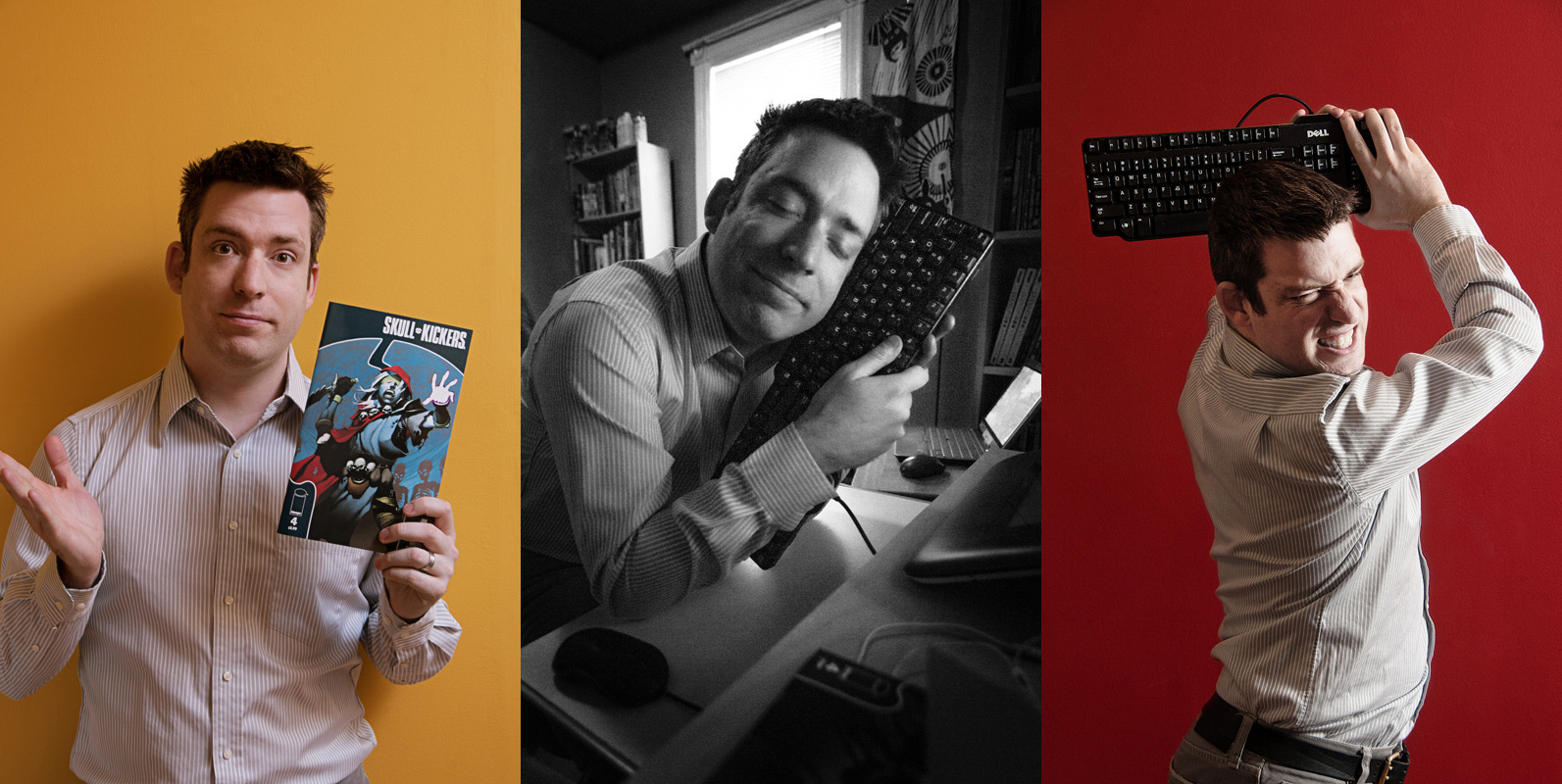
Writer and Artist Jim Zub: My Life As A Gamer

Being the writer of comics like Skullkickers and the Pathfinder adaptation from Dynamite Comics, it probably shouldn't surprise anyone that Jim Zub is a gamer. Jim Zub is a writer, artist and art instructor based in Toronto, Canada. Over the past ten years he’s worked for a diverse array of publishing, movie and video game clients including Disney, Warner Bros., Capcom, Hasbro, Bandai-Namco and Mattel. He is also a project manager for UDON Entertainment (which a few of you should probably know about).

He took some time out of his busy schedule to answer a few questions for me about his life as a gamer.


With what game did you get started down the path of tabletop RPGs? About how old were you when you started?

My brother and I received the classic D&D Basic ‘Red Box’ when I was around 8 years old and he was 12. Our older cousins got us hooked on D&D and we played voraciously, even though the rules were really confusing to us at times. We didn’t realize there was a difference between D&D and AD&D at first, so we were mixing and matching rule books and modules from both systems. We figured it out eventually.

What are some of your favorite games?

I’ve been playing RPGs for almost 30 years and have gone through all sorts of phases where a particular game really hit the spot. A few high points, old and new: D&D, Call of Cthulhu, TMNT and Other Strangeness, Robotech, Vampire the Masquerade, Feng Shui, Adventure! and Pathfinder.

What is the ongoing appeal of tabletop RPGs for you?

I love the collaborative storytelling nature of it. Everyone at the table is going to contribute to the story and we don’t know exactly where it’ll go but we’re all involved. There’s a wonderful spontaneity to it. With the right group just about any game system or setting can be enjoyable and entertaining.

Are you primarily a GM or a Player? Which do you prefer?
Since high school I’ve primarily been the GM. I like managing the world and NPCs that whirl around the cast, rolling with the players’ choices and expectations.

How is comic writing different from making up stuff for a game? How do the two processes complement each other for you?

Running a good tabletop game is about balancing player needs and everyone’s entertainment, while writing comics is about creating a more cohesive plot and dramatic pacing. They both involve a lot of creativity, but GMing a game isn’t just about one story or a singular narrative voice.

Playing and running games has taught me a lot about how characters interact and made it far easier for me to “get into character”. I imagine characters in a scene, I know their motivations and I’m able to generate dialogue that reflects their personality.

If you could write a comic adaptation of any RPG, what would it be and why?

Dungeons & Dragons obviously springs to mind. The name carries such powerful nostalgia for me and gamers at large. Having a D&D story in my repertoire would be pretty great. If it could be a comic story set in the kooky Planescape campaign setting, even better.

I’d also be thrilled to push outside of people’s expectations of my work and do something darker like Call of Cthulhu or Vampire the Masquerade. They’re both great properties with atmospheric and emotional intensity.

If you have one of your comics adapted to an RPG, which would it be and why?
Skullkickers is the natural choice, of course. It’s my love letter to RPGs and sword & sorcery that marinates itself in the pulp fantasy tropes I learned from tabletop gaming. It would complete some sort of cosmic cycle of game-comic-game that would probably tear a hole in the fabric of our reality.

Saturday, June 22, 2013

How The Live Action Gatchaman Trailer Leads To Thinking About Game Design

My love for Gatchaman is pretty well known. I've loved the idea since I watched Battle of the Planets as a kid with my little brother. Back in the day, Gold Key even did a comic based on the American version of the cartoon. We had a couple of issues of it back then. Now, there's been a live action movie made of Gatchaman in Japan. By all that is holy I hope that there is an English translation.


Along with Speed Racer, this has always remained one of my favorite anime series since I was a kid. These are also the two properties that I would most love to design official tabletop RPGs for. However, don't be surprised if Gatchaman or Speed Racer sneaks into my new edition for HeartQuest. These guys may have to sneak into 4C Space. I already have an idea for one Earth-based group that deals with aliens. Adding Science Ninjas would make the sneaking even easier.

This is a great trailer. Watch it over and over.

The things that can inspire us as game designers are many and varied. The trick is to retexture them in such a way that they are new and fresh, while still having a nod to the originals. That can be a thin line to tread a lot of the time, and it isn't always successful. Some say that there really aren't many original ideas anymore. This is probably true, but there are ways to present things that are new, or at least new to you. I think that a game designer should have their own unique viewpoint that they stamp on things, so even if you are just doing a knock off of someone else's creations you can still do it in a way that makes things look new. Developing that viewpoint is what can be difficult.

Designers should look outside of the comfort of what they would want to do in their everyday life. Look for new books, new movies, new music, new voices that speak of different perspectives that will enrich what has already formed your worldview. A lot of designers and gamers are anti-anime, so taking a concept like that from Gatchaman and turning it inside out, so that it doesn't look like anime to the unbelievers, can take some work. Look at the characters from a horror viewpoint, and turn them into occult investigators. Make the giant monsters into something summoned by unscrupulous necromancers. There are many ways to take something old and turn it into something new.

This is how game designers should be thinking, always outside of the box. Look beyond the fantasy novels, and mouldering books of the Appendix N, and make your fantasy worlds something different. Look into the science fiction of other nations, cultures who might not speak English, for clues as to how to take your own ideas into new directions. There's a big world out there, just outside of the zone of what we may normally read or watch...embrace it.

Friday, June 21, 2013

ConTessa Panel on Hangout/Online Gaming

For the last year or so I have run a regular weekly game by Google+ Hangouts. We rotate things, and have even switching off GMing a couple of times, but we have had mostly that same core group of people for the weekly game that entire time. I told the story of how our G+ Hangout on the Air gaming started in a couple of posts here on the blog already, so I won't go into that. But after doing this, both in live broadcast and private hangouts, I was asked to join the panel and talk about using Hangouts for online gaming.

The panel was run by +ConTessa organizer +Stacy Dellorfano, and the other panelists were +Kristin Carlson (of +Roll20), +Rachel Ventura (of +Frog God Games) and +David Rollins (of Canada). David has done a lot of playtesting via Hangout, and he and Stacy are in my weekly hacked Swords & Wizardry game. There were varying levels of experience with Hangout Gaming, so that added some depth to how we addressed things. Rachel and Kristin also gave their experiences with using Virtual Tabletops (VTTs) in online gaming. It was very informative.


I was resistance to online gaming for a very long time, but I am glad that I have started doing it, because I have spent the last year gaming with a great group of people that I now consider to be (almost) friends. Seriously, though, if you haven't tried Hangout gaming, or any version of online gaming, because it "isn't the same as gaming face to face," I really think that you should at least give it a try. This has been some great gaming that I would have missed out on if I hadn't decided to give it a try last year.

4C Space: Angels in the Architecture

Super-hero comics are filled with divine, infernal, celestial and extradimensional beings. It isn't unusual for a god or demi-god to join a team of super-heroes in any of the comic book universes. In this 4C Space post I talk about a group of celestial beings wandering the universe following a divine plan, and sometimes seeking vengeance in the name of their Lord.

By the way, if you aren't familiar with the 4C rules, check out the page that I made for them here.

Thursday, June 20, 2013

Dorkland! Roundtable with John Wick

I spoke to John Wick about his background in gaming on the Dorkland! Roundtable. As many of these have ended up, he and I talked more than a bit about the impact of Kickstarter on tabletop RPGs and how publishers and designers who wish to remain successful at crowdfunding need to establish an economy of trust with their customers. More and more, I think, those publishers and designers who misspend the money raised through Kickstarter as well as their time with chronically late projects will find it harder and harder to raise money through this method.


Check out our conversation, and see us talk about all of this and more.

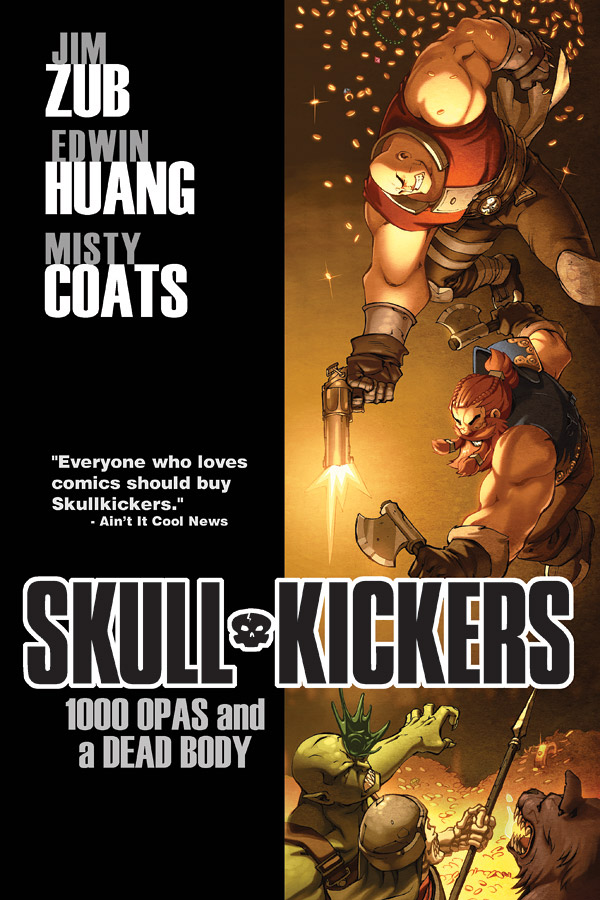
Skullkickers: 1000 Opas and A Dead Body

To me there are two schools of fantasy fiction, as it applies to gamers: the fantasy fiction they think represents their campaigns and the fantasy fiction that does represent their campaigns. Skullkickers from Jim Zub and Image Comics is very much in the latter category.

I mean that as a compliment.

I finished this week the first trade of Skullkickers, it was my first exposure to the comic (although I had heard a lot of good comments about it online. Skullkickers, like a good band of fantasy adventurers, takes its name from a "heroic act" done by one of the characters during a fight with the big monster. I won't spoil it, but I wouldn't be surprised if people tried this with their characters in fantasy games.


The characters in Skullkickers spend a lot of time in bars, not surprisingly. If anyone else's fantasy campaigns are like the ones that I run, everyone's characters spend a lot of time in bars.

I enjoyed the art, and the fast pace of Zub's writing. They come together to give the comic an animated cartoon feel that I really liked. It has an anime feel to it that, while not everyone may like, it definitely appealed to me. The art as much as the writing adds a lot to the characterizations of our protagonists (I hesitate to call them the heroes), which is interesting because the characters aren't actually named in story. To be honest, I didn't even notice this until I was reading the introduction to the reprint of the first appearance of these characters (from the Image Comics published Popgun comic) talked about how The Man With No Name was an influence. Considering some of the terrible character names that I've encountered in my 30+ years of gaming, I think this approach is a good one.

The more that I read of Skullkickers, the more that I want it to be turned into an RPG, to be honest. I think that it would fit well in a game with an old school approach, like Swords & Wizardry or Labyrinth Lord. I don't know that I would want a character to have to deal with Shorty and Baldy during an adventure (most player characters are already disruptive enough) but the world of Skullkickers is very engaging and I want to explore it at ground level, inside the world, as well as read more of the comics. It is interesting that I am not a big fan of fantasy fiction, preferring the works of only a couple of authors in fiction, but I love it when fantasy is done in comics. Part of me would love to see a crossover between these guys and Travis Morgan.

OK, so, do I recommend buying this comic? A most emphatic yes. This trade is one of the most exciting comics that I have read in recent months. If, for some weird reason, you need to be further sold on this, there is a webcomic version of the early adventures of these guys. But you really should pick up 1000 Opas and A Dead Body on your next trip to the comic store. It is just that much fun of a comic.

Wednesday, June 19, 2013

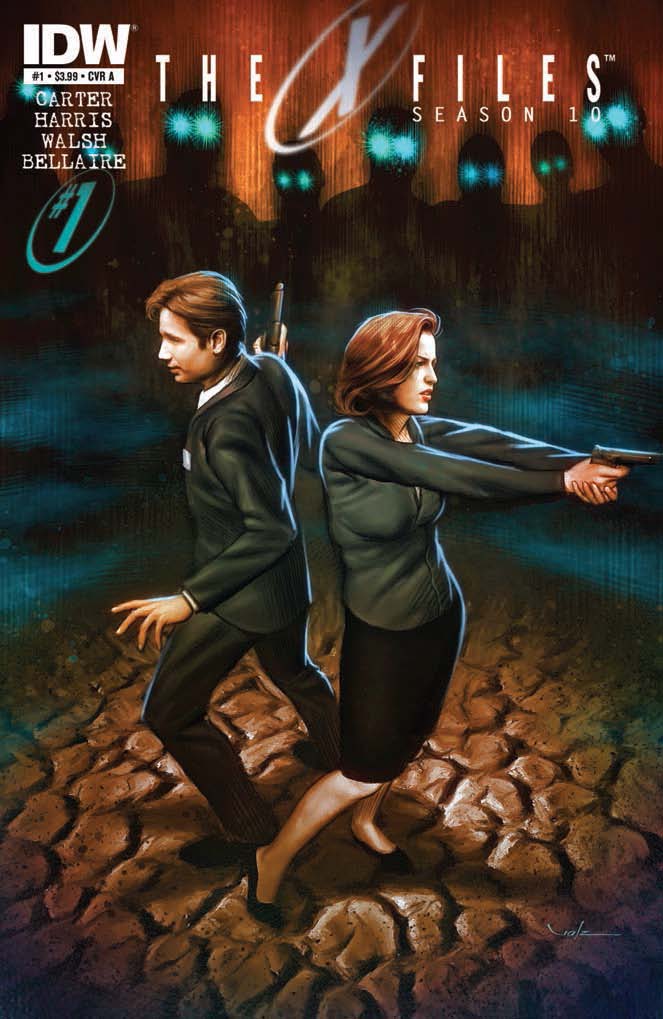
X-Files Season 10 - First Issue

There is a new X-Files comic hitting the news stands and comic shops today. Is it worth picking up?

Tuesday, June 18, 2013

X-Files Season 10 Comic Preview


After the movies. After the television show. A new X-Files comic from creator/Executive Producer Chris Carter and IDW Publishing. Now you can see the cover and the first few pages of the book.


IDW Publishing's Star Trek/Legion of Super-Heroes Crossover In Review

IDW Publishing and DC Comics crossed over two of the venerable properties of science fiction: Star Trek and the Legion of Super-Heroes. The Legion has almost a decade on Star Trek, but they are both the product of the hopefully optimistic sub-genre of science fiction that was prevalent in the 50s and 60s. Thankfully, this mini-series (written by the ever prolific Chris Roberson) did not take the route of all too many contemporary comics by adding a veneer of "reality" to this hopefulness by making the characters suddenly grim and gritty.

The story is steeped in the mythology of both universes, and the characters are true to their origins. Roberson has done a much better job than a lot of crossover writers in this regard. I think that I would have liked it better if the motivation behind the crossover was from the original Star Trek series instead of something from The Next Generation, but overall that is probably a minor quibble.

I did like the little touches of characterizations, like Kirk flirting with Shadow Lass or Cosmic Boy talking about history. I do think that the bits between Spock and Brainiac Five probably should have been a bit more contentious, but I think that Brainiac Five's exasperation with Spock, at times, was a good handling of how the character would react to having to deal with another intelligent scientist being in the room. There were a lot of characters to deal with in this crossover, but I think that McCoy and Uhura were a bit shortchanged.

I did like melding the alternate timeline with classic DC Comics science fiction characters, and the Star Trek characters being convinced that they were in the Mirror Universe was funny at times.

Overall, this was a well done comic. Roberson's writing was better in this book than in other recent crossovers that I have read by him, but I think that is probably due to having a freer hand from editorial edicts. The writing is sharp, the characterizations are spot on and the overall plot is engaging. Roberson does just to the characters and tries his best to give everyone as much screen time as possible, within constraints of the story. Not only do I recommend picking this up, but I hope that this did well enough to warrant future crossovers. I would love to see a story that allows the characters to deal with each other's universes, rather than the "crossover world" created for this. I think that we need to see a scene where Scotty tries to correct Brainiac Five's repairs of the Enterprise.

The trade edition of this comic is out and available in comic stores now. Rush to your local comic store and pick up your copy today.